
![[Complete Guide to Kansai International Airport] Make the Start and End of Your Trip Comfortable and Fulfilling!](https://static.gltjp.com/glt/data/article/21000/20884/20241224_164815_f6c01a59_w1920.webp)
[Complete Guide to Kansai International Airport] Make the Start and End of Your Trip Comfortable and Fulfilling!
Kansai International Airport is often the gateway for trips to the Kansai region, including Osaka and Kyoto.
It is one of Japan’s leading airports, offering a full range of domestic and international flights and operating 24 hours a day.
Its vast grounds include not only arrival and departure floors, but also many appealing facilities that help make travel more comfortable.
This article introduces the airport’s layout and the kinds of shops you’ll find inside.
It’s a complete guide that also covers recommended shops to make your time there more worthwhile, as well as popular spots nearby, so be sure to read to the end.
What is Kansai International Airport Like?
Kansai International Airport is the gateway to western Japan, with many scheduled international and domestic flights and Approx. 30 million travelers using it each year.
Located on an artificial island about 5 km off the Senshu coast in Osaka Bay, it is also famous as the world’s first offshore airport built entirely on an artificial island. It is also affectionately known as KIX, based on its airport code.
At the airport, you can enjoy shopping and a wide range of gourmet food worthy of Osaka, the city known for its love of eating.
In addition, Kanku Observation Hall Sky View is packed with attractions for more than just travelers, including the Sky Deck, where you can watch aircraft take off and land in a 360-degree panorama, and the Sky Museum, where you can learn about the airport and airplanes in a fun way.

Main Destinations Served by Kansai International Airport
- Domestic Flights
- Tokyo (Haneda Airport) / Chiba (Narita Airport) / Sapporo (New Chitose Airport) / Sendai (Sendai Airport) / Hiroshima (Hiroshima Airport) / Nagasaki (Nagasaki Airport) / Miyazaki (Miyazaki Airport) / Fukuoka (Fukuoka Airport) / Kagoshima (Kagoshima Airport) / Okinawa (Naha Airport), etc.
- International Flights
- Seoul (Incheon International Airport and others) / Beijing (Beijing Capital International Airport and others) / Shanghai (Shanghai Pudong International Airport) / Taipei (Taiwan Taoyuan International Airport) / Bangkok (Suvarnabhumi Airport and others) / Singapore (Changi Airport) / Sydney (Sydney International Airport) / Dubai (Dubai International Airport) / Los Angeles (Los Angeles International Airport) / Paris (Paris-Charles de Gaulle Airport), etc.
What Facilities Does Kansai International Airport Have?
Kansai International Airport is divided into Terminal 1 and Terminal 2, each with its own distinct features.
Especially if you are using the larger and busier Terminal 1, having a general idea of its layout will help you get to your destination smoothly after arriving at the airport or before heading home.
The following explains what you can find in each building, so use it as a reference.
Terminal 1 Building, Where All Flights Except LCCs Arrive and Depart
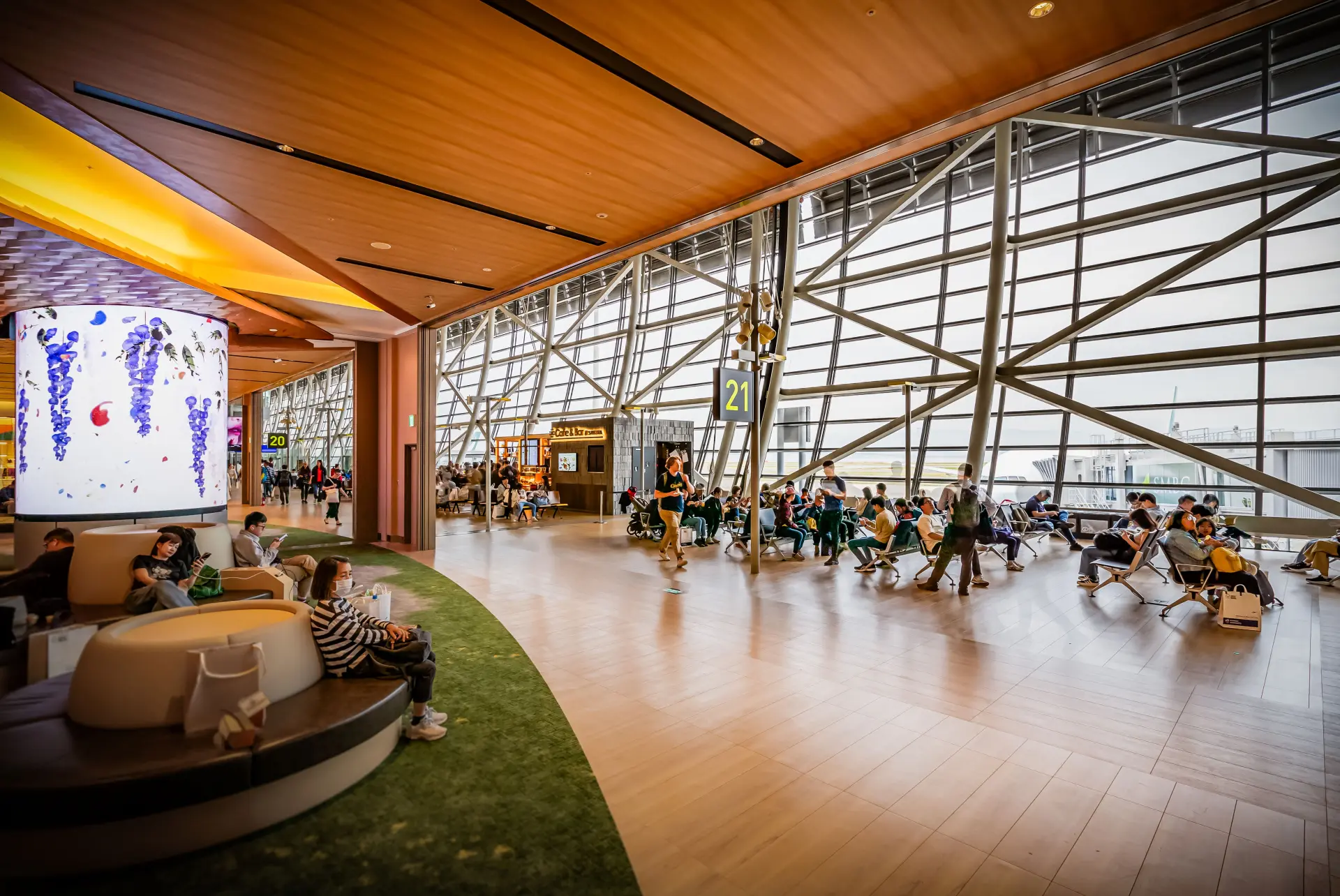
The four-story Terminal 1 Building is the main terminal at Kansai International Airport, handling all international and domestic flights except those operated by LCCs (low-cost carriers).
In addition to arrival and departure floors, it also offers transportation access such as rail, limousine buses, and taxis, as well as currency exchange counters and other essential travel services.
Thanks to a major renovation that reorganized the domestic flight area, expanded the international flight area, and introduced the latest security screening system, the terminal now offers less congestion and smoother passenger flow.
The lounges that had previously been scattered throughout the airport were consolidated into one location and redeveloped as a shared international lounge.
There are two types, Business and Premium, with about 800 seats in a space decorated with Japanese-style design elements.
There is also a wide selection of shops, including duty-free stores you can use on arrival, luxury brand boutiques, and popular Osaka restaurants. It is also convenient for buying souvenirs or taking a break before departure.
In summer 2026, the international north and south commercial areas are scheduled to be expanded.
A total of 23 new shops are expected to open, including duty-free stores and shops in a wide range of categories.
Terminal 2 Building, Where LCC Flights Arrive and Depart
Terminal 2 Building is a single-story terminal used by domestic and international LCC flights, including Peach Aviation.
It is likely to be used often by travelers who prefer efficient, budget-friendly trips and by people traveling mainly around Asia.
With a simple yet functional one-floor layout that includes the domestic gate area, international check-in, and the international gate area, the distance to the boarding gates is relatively short.
Inside, you will find all the basics, including a convenience store, restaurants, duty-free shops, and a currency exchange shop, so you should have no trouble before or after your flight even though the number of facilities is limited.
It is also open 24 hours a day, and facilities such as free Wi-Fi, multipurpose restrooms, and power charging areas are another welcome plus.

Access to Terminal 2 Building
Because Terminal 2 Building is located away from Terminal 1 Building, if you are coming via the nearest station, Kansai Airport Station, you will need to take the free shuttle bus.
The bus stop is on the first floor of Aeroplaza, and the ride takes Approx. 7 to 9 minutes.
Buses run at intervals of about 10 minutes at most, so you do not need to worry about checking a timetable.
For major spots in Osaka such as in front of Osaka Station and Universal Studios Japan, the direct paid limousine bus is convenient.

Aeroplaza/Hotel Nikko Kansai Airport, Directly Connected to Terminal 1 Building
Aeroplaza is an 11-story complex adjacent to Kansai International Airport.
It is connected to Terminal 1 Building by a passageway and can be reached on foot, which is one of its biggest advantages.
Floors 1 through 3 include restaurants, a convenience store, rest spaces, and shower rooms.
Many facilities are open 24 hours a day to accommodate late-night and early-morning users, making it easy to spend your time comfortably before or after a flight.
There are also bus and taxi stands, as well as rental car services, so it also functions as a transportation hub from the airport to various destinations.
Hotel Nikko Kansai Airport occupies floors 4 through 11 and offers a total of 576 guest rooms, with high-quality service that is well regarded by guests.
Please refer to the section below for more details about the hotel.

How to Choose Between Kansai International Airport and Osaka International Airport (Itami Airport)
Osaka is also home to Osaka International Airport (Itami Airport), which spans Toyonaka City and Ikeda City in northern Osaka and Itami City in Hyogo Prefecture.
It is about one hour by car from Kansai International Airport, and because the two airports have different features, it is best to choose between them depending on your purpose and travel situation. The table below summarizes the differences between the two airports.
| Airport | Main Use | Access to Osaka Station | Features |
|---|---|---|---|
| Kansai International Airport | International flights and domestic LCC flights | Approx. 50 minutes by train from Kansai Airport Station |
,Served by many airlines, with a wide variety of flights and options ,Operates 24 hours a day, including late-night and early-morning flights ,Good access to southern Osaka and the Wakayama area |
| Osaka International Airport (Itami Airport) | Domestic flights | Approx. 35 minutes by train and other transport from Osaka Airport Station |
,Convenient for travel to major domestic cities such as Tokyo, Sapporo, and Fukuoka ,Close to central Osaka, with direct limousine buses to other areas in Kansai ,Compact airport size makes getting around smooth |
Best Places to Eat at the Airport! 3 Popular Restaurants in Kansai International Airport
Kansai International Airport has a great selection of restaurants where you can enjoy Japanese cuisine and local specialties from the Kansai region.
You can also savor authentic Osaka flavors, making it a great place for a meal at the start or end of your Kansai trip.
Here are three especially popular restaurants, so stop by if you get the chance.
1. All Day Dining “The Brasserie”
All Day Dining The Brasserie, located on the second floor of Hotel Nikko Kansai Airport, is a buffet-style restaurant.
It offers a full menu from breakfast to lunch and dinner, and the refined, modern interior makes it easy to enjoy a special dining experience at any time of day.
The Japanese and Western dishes made with seasonal ingredients are carefully prepared and visually appealing.
From cold dishes to desserts, there is a wide selection, and everything is delicious and high quality, so it should feel well worth the price.
Another nice point is that there is no time limit, so you can relax and enjoy as much as you like.

2. Takoyaki Kappo Takomasa
Takoyaki Kappo Takomasa, located in the food court on the second floor of Terminal 1 Building, is a specialty takoyaki shop that has been loved for over 30 years.
Its carefully selected ingredients, secret batter, and flavor packed with the taste of octopus have also earned strong support from locals in Osaka.
Each freshly made, piping-hot serving is full of care, with the perfect texture, crispy on the outside and soft and creamy on the inside.
The most popular menu item is the classic takoyaki with sauce flavor, but the slightly unusual soy sauce flavor takoyaki and akashiyaki served with dashi broth are also recommended.
With long hours from 7:00am to 10:00pm, plus both eat-in and takeout available, it is also easy to stop by for a quick bite.

3. Dotonbori Kamukura
Dotonbori Kamukura is located at the southern end of the food court on the second floor of Terminal 1 Building.
This popular ramen shop has its main branch in Dotonbori, Osaka, and is known for its original ramen created by its founder, who previously worked as the owner-chef of a French restaurant.
The mellow, gently savory soup, smooth egg noodles, and carefully selected ingredients come together in harmony to create a distinctive flavor unlike any other.
The gyoza, crispy outside and juicy inside, are also excellent, as is the fried chicken that won the Gold Prize in the Central Japan Soy Sauce Sauce Division at the 7th Karaage Grand Prix.

3 Souvenir Shops in Kansai International Airport to Visit Before Heading Home
Kansai International Airport has many appealing shops, including one of the largest duty-free stores in Japan, making it a convenient place to shop for souvenirs before heading home.
With a wide selection that includes famous sweets, local specialties, and airport-exclusive goods, you are likely to find something you like.
Here are three recommended souvenir shops in easy-to-use locations, so use them as a reference.
1. Kansai Tabinikki Terminal 2 Domestic Lobby Store
Kansai Tabinikki, located in the lobby before the security check in Terminal 2 Building, is a shop packed with the charms of the Kansai region.
Its diverse lineup includes famous Osaka sweets, specialty products, trending gourmet items, specialties from nearby areas such as Kyoto and Kobe, and even airport-exclusive items.
It also carries many popular character goods and practical everyday items, making it suitable for a wide range of shoppers.
You should be able to find the perfect souvenir, whether for yourself or as a gift.
Although the store is compact, the products are arranged efficiently, so you can enjoy shopping smoothly even if you only have limited time before your flight.

2. SOUVENIR Kansai Tabinikki North Wing Store
SOUVENIR Kansai Tabinikki, located on the second floor of the North Wing in Terminal 1 Building (international departure area), is a shop with a rich selection of items for visitors to Japan.
It mainly carries sweets and miscellaneous goods from across Kansai, including Osaka, Kyoto, and Kobe, making it ideal for choosing travel keepsakes or gifts for loved ones.
Another appealing point is that it is easy to stop by before departure or after arrival, and you can shop comfortably even with limited time.
The staff’s polite service and easy-to-browse displays are also well regarded, and you should be able to find something that feels distinctly Kansai.
It also stocks travel essentials and medicine, so it is useful for forgotten items or unexpected purchases.
Because it has all the products tourists are likely to want, it is worth remembering both the shop’s name and location.

3. KIX DUTY FREE North Wing Central Store
KIX DUTY FREE North Wing Central Store, located on the second floor of the North Wing in Terminal 1 (international departure area), is a duty-free shop for international travelers.
Because it is close to the SOUVENIR Kansai Tabinikki mentioned above, it is also recommended to visit both if you have time.
The shop offers a wide selection of well-known domestic and international brands, with a varied lineup that meets travelers’ needs.
It is especially nice that popular items such as perfume, cosmetics, brand-name bags, watches, and tobacco are available at duty-free prices.
As uniquely Japanese souvenirs, traditional sweets and high-quality sake are also popular with international visitors.
There are many considerate staff members who are proficient in English and other languages, so even visitors who do not understand Japanese should be able to shop comfortably and with peace of mind.

Places to Stay Near Kansai International Airport You Should Know in Advance
Near Kansai International Airport, there are accommodations that support a comfortable stay.
If you arrive late at night when public transportation is no longer running, they are convenient for slowly organizing your luggage, getting ready for the next day, and resting after your journey.
If you are transiting through the airport, cabin-style accommodations available for just a few hours can help you refresh.
It is also useful to know these places in advance in case of flight delays or cancellations caused by unexpected trouble.
1. Hotel Nikko Kansai Airport
Hotel Nikko Kansai Airport is the only airport hotel directly connected to Kansai International Airport.
Located just a few minutes on foot from Terminal 1 Building, it is especially attractive for travelers using early-morning or late-night flights.
The hotel features a refined design and calm atmosphere, with 576 comfortable guest rooms divided into four categories.
Along with outstanding convenience and a comfortable stay, the view of aircraft taking off and landing from some rooms offers a special experience unique to this hotel.
Inside the hotel, you will find a variety of restaurants serving Japanese, Chinese, and Western cuisine, making it easy to enjoy a quality meal before or after your flight.
There are also many welcome services for travelers, including a 24-hour front desk and free luggage storage.

2. First Cabin Kansai Airport
A reasonably priced hotel located on the third floor of a complex directly connected to Kansai Airport Station on multiple lines.
Its location within easy walking distance of Kansai International Airport is another plus, and it welcomes not only overnight stays but also short-stay users from 2 hours.
Inside the hotel, there are a total of 153 neatly arranged cabins for men and women, creating a stylish and futuristic atmosphere.

Notable Spots at Kansai International Airport Worth Visiting If You Have Time
If you have a little extra time at Kansai International Airport, try visiting the spots introduced below.
In addition to places where you can watch aircraft take off and land up close, there is also a hot spring where you can relax and recover from the fatigue of travel.
1. Kansai International Airport Kanku Observation Hall “Sky View”
Kanku Observation Hall Sky View is located about 320 meters from Runway A, the airport’s main runway, and offers a variety of content across floors 1 through 5.
On the rooftop, there is the Sky Deck, where you can enjoy a 360-degree panoramic view and watch aircraft take off and land up close.

2. Natural Hot Spring Senshu no Yu Kansai Airport
At Natural Hot Spring Senshu no Yu Kansai International Airport, you can enjoy a relaxing soak while looking out over Osaka Bay.
On clear days, the location offers sweeping views all the way to Mt. Rokko and Awaji Island.
One of its special pleasures is soaking in the open-air bath while feeling the sea breeze and watching aircraft take off and land, as well as boats passing by.
In addition to the scenery, the quality of the spring water is also a major attraction. Senshu Onsen, pumped up from 800 meters underground, is also known as a “beauty bath” because of its skin-beautifying properties.

Nearby Sightseeing Spots Around Kansai International Airport to Visit Before Heading Home
If you find yourself with extra time around Kansai International Airport, try visiting the sightseeing spots introduced below.
You may come across an unexpected encounter or discovery.
Rinku Premium Outlets
An outlet mall located in a section of Rinku Town across the water from Kansai International Airport, it is also popular with international visitors.
Its fifth expansion phase was completed in August 2020, the 20th anniversary of its opening, making it the largest outlet mall in western Japan.
With popular domestic and international brands gathered here, you can buy top-brand items at great prices. The fifth expansion enlarged the Seaside Area, bringing the number of stores to about 250.

Rinku Park
A nature-rich Osaka Prefectural park located in a section of Rinku Town across the water from Kansai International Airport.
Set in a prime seaside location, it is a spot where you can watch beautiful sunsets slowly sinking below the horizon and aircraft taking off and landing up close.
It is divided into two areas, Symbol Green Space and Seaside Green Space, each filled with highlights such as walking paths, cafes, and sightseeing spots.
Particularly famous and popular are Marble Beach, which creates a spectacular view with its white marble stones against the blue sky and sea, Taiko Bridge, which overlooks the entire park, and LOVE RINKu, known as a sacred place for couples.
The park is open 24 hours a day year-round, and admission is free, making it perfect for international visitors who want to fill a bit of spare time.

Popular Tourist Destinations Easy to Access from Kansai International Airport
As the gateway to western Japan, Kansai International Airport is often the starting point for trips to a variety of sightseeing destinations.
Here, we introduce the appeal and highlights of popular places that are easy to access from the airport.
You may discover somewhere unexpected or find a place you have been considering, so if you are not sure where to go, use this section as a guide.
3 Popular Tourist Spots in Osaka, the City of Food
Central Osaka is a sightseeing city full of energy and smiles that attracts travelers from Japan and abroad.
The city has the lively atmosphere Osaka is known for, with iconic landmarks such as the Glico sign and giant crab displays scattered throughout.
Known as the city of kuidaore, or eating until you drop, it is also a place where you can easily enjoy Osaka specialties such as takoyaki, okonomiyaki, and kushikatsu.
It also offers excellent shopping and entertainment, and you can experience authentic comedy culture all around the city.
The access route and travel time from Kansai International Airport (Kansai Airport Station at Terminal 1) to Osaka Station are as follows.
- Route
- Take the JR Limited Express Haruka from JR Kansai Airport Station and get off at Osaka Station ※ JR Kansai Airport Rapid Service is also available
- Travel Time
- Approx. 45 minutes

1. Osaka Castle Main Tower
Construction of Osaka Castle Main Tower began in 1583 under Toyotomi Hideyoshi, who achieved national unification during the Azuchi-Momoyama period (1568–1600), and it was completed in 1585.
Inside is a history museum with permanent exhibits such as Miniature Summer Siege, a figure recreation of the Summer Siege of Osaka folding screen, and a full-scale model of the golden tea room used by Hideyoshi. Special and themed exhibitions are also held regularly.

2. Dotonbori
Dotonbori is known for its lively streetscape, where giant three-dimensional signs shaped like crabs, octopuses, cows, cranes, and more jut out over the street.
Many restaurants line both the Dotonbori River on the north side and the main street on the south side. The main street is a pedestrian-only zone, and you will often see people enjoying street food such as takoyaki as they walk around.

3. Abeno Harukas
A super high-rise complex building that opened in 2014 and stands 300 meters above ground.
From basement level 2 to the 14th floor, it houses Abeno Harukas Kintetsu Main Store (Kintetsu Department Store) and Abeno Harukas Dining.
The observation deck Harukas 300 spans the 58th, 59th, and 60th floors. Reached by a dedicated elevator from the entrance gate on the 16th floor, the top 60th floor features an indoor corridor surrounded by glass from floor to ceiling, creating the striking sensation of walking in the sky. When the weather is clear, you can see as far as Kyoto, the Rokko mountain range, Akashi Kaikyo Bridge, Awaji Island, and the Ikoma mountains.


3 Popular Tourist Spots in Kyoto, the Ancient Capital with Traditional Japanese Atmosphere and Historic Culture
Kyoto, the ancient capital where Japan’s history and culture remain deeply rooted, is known for its beautiful seasonal scenery and traditional streetscapes.
The area is dotted with world-famous shrines and temples whose magnificent architecture and solemn atmosphere captivate visitors.
Another of Kyoto’s charms is the sense of seasonal change.
In spring, cherry blossoms color the city, in autumn the leaves turn brilliant shades, in summer riverside dining platforms bring a sense of coolness, and in winter temples and shrines blanketed in snow take on a magical appearance.
Kyoto also has a rich food culture, where you can enjoy refined flavors such as shojin cuisine, Kyoto kaiseki, and matcha sweets.
The access route and travel time from Kansai International Airport (Kansai Airport Station at Terminal 1) to Kyoto Station are as follows.
- Route
- Take the JR Limited Express Haruka from JR Kansai Airport Station and get off at Kyoto Station ※ Airport limousine bus is also available
- Travel Time
- Approx. 1 hour 20 minutes

1. Otowasan Kiyomizu-dera Temple
Founded in 778 and registered as a UNESCO World Cultural Heritage site in 1994, Kiyomizu-dera Temple has more than 30 halls and monuments, including National Treasures and Important Cultural Properties, spread across its 130,000-square-meter grounds on the mountainside of Mt. Otowa. Kiyomizu-dera is also famous for its seasonal beauty, with cherry blossoms in spring, greenery in summer, autumn leaves in fall, and snow in winter.
To the east of the main hall flows Otowa Waterfall, from which the temple takes its name. Draw one of the three streams of sacred water with a ladle and drink it while praying for purity of mind and the fulfillment of your wishes.

2. Fushimi Inari Taisha Shrine
Founded in 711, this is the head shrine of the Inari shrines said to number around 30,000 across Japan, and it has long been revered nationwide as a deity of abundant harvests, prosperous business, household safety, recovery from illness, and the fulfillment of wishes.
One of its most famous highlights is the Senbon Torii, a tunnel-like path of vermilion torii gates lined up behind the main hall. They began as offerings from worshippers giving thanks and prayers, and across all of Mt. Inari there are said to be more than 10,000 gates.

3. Kinkaku-ji Temple (Rokuon-ji)
A temple that originated from Kitayama-dono, the residence of Ashikaga Yoshimitsu, the third shogun of the Muromachi shogunate.
Named Rokuon-ji after Yoshimitsu’s Buddhist name, it became an outlying sub-temple of Shokoku-ji, which he himself founded.
The common name Kinkaku-ji comes from the golden Shariden hall standing by the pond. Its shingled roof made of thin cypress boards and the pure gold leaf applied to the second and third floors with lacquer as adhesive still convey the splendor of Ashikaga Yoshimitsu’s age.


3 Popular Tourist Spots in Nara, with an Even Older History Than Kyoto
Nara, home to Japan’s largest number of three World Heritage sites, is a historic destination where the atmosphere of the ancient capital and rich culture still live on.
From Horyu-ji, the world’s oldest wooden building, to Todai-ji, home to a giant Buddha of overwhelming scale, Nara preserves exquisite designs that have endured through the ages.
It also has many famous spots for cherry blossoms and autumn leaves, and the beautiful scenery in harmony with nature, along with breathtaking views from shrines and temples, are among its many attractions.
It is recommended for those who want to get away from the bustle and spend time at a relaxed pace.
The access route and travel time from Kansai International Airport (Kansai Airport Station at Terminal 1) to Nara Station are as follows.
There are only five direct limousine buses a day (Approx. 1 hour 40 minutes), so depending on the time, it may also be worth considering the bus.
- Route
-
1. Take the Nankai Airport Line Airport Express bound for Namba from Nankai Kansai Airport Station and get off at Shin-Imamiya Station
2. From JR Shin-Imamiya Station, take the JR Yamatoji Rapid Service bound for Nara and get off at Nara Station - Travel Time
- Approx. 1 hour 30 minutes
1. Nara Park
A park where you can enjoy both precious historic and cultural heritage sites such as Kasuga Taisha Shrine, Kofuku-ji Temple, Todai-ji Temple, Nara National Museum, and Shosoin, as well as the grand and abundant natural beauty of the surrounding greenery.
Located in the center of the city, it is also attractive for its easy access to many sightseeing spots.
Many features of the area are designated Natural Monuments, including Kasugayama Primeval Forest (a Special Natural Monument), the Nara deer, the Nagi forest within Kasuga Shrine precincts, the Naranoyaezakura cherry trees of Chisokuin, and the Luehdorfia japonica habitat.

2. Todai-ji Temple
The Vairocana Buddha commissioned by Emperor Shomu during the Nara period was consecrated in 752.
Todai-ji, one of Nara’s most representative temples, was then developed over nearly 40 years as its temple complex was completed. Even after the capital moved from Heijo-kyo, it continued to prosper under strong protection.
In 1180 and again in 1567, most of the temple complex, including the Great Buddha Hall, was destroyed by fire during warfare, but it was rebuilt in the Kamakura and Edo periods with the help of many people.

3. Asuka Village, Ishibutai Tumulus
A tumulus located in the Ishibutai Area of the National Asuka Historical Park, which has a total area of Approx. 60 hectares and consists of five areas: the Takamatsuzuka Surrounding Area, home to Takamatsuzuka Tumulus; the Amakashi-no-Oka Area, which has an observation deck overlooking the Asuka landscape; the Iwaido Area, with a walking path leading to Ishibutai Tumulus; the Kitora Tumulus Surrounding Area; and the Ishibutai Area itself. The park was developed for purposes such as protecting the area’s rich nature and cultural heritage.


3 Popular Tourist Spots in Kobe, a City Full of Charm Led by Gourmet Delights
Kobe is a port city with a unique atmosphere where refined urban modernity and an international feel come together.
Its open views of the sea and beautifully illuminated harbor nightscape captivate visitors.
From the Ijinkan foreign residences that preserve the look of the Meiji period (1868–1912) to the nature-rich Mt. Rokko, Kobe also has many highlights where history and culture intersect.
And when it comes to Kobe, food is another must. From world-famous Kobe beef to fresh seafood and bakeries, the city’s wide variety of cuisine makes travel there even more enjoyable.
The access route and travel time from Kansai International Airport (Terminal 1 limousine bus stop) to Sannomiya Station, the center of sightseeing in Kobe, are as follows.
- Route
- Take the bus bound for Kobe Sannomiya and Rokko Island from Terminal 1 Limousine Bus Stop No. 6 and get off at Sannomiya
- Travel Time
- Approx. 1 hour 5 minutes
1. Kobe Harborland
Kobe Harborland is the name of a waterfront area covering about 18.5 hectares and lined with several large-scale complex facilities.
One of its commercial facilities, Kobe Renga Soko, was originally a cargo warehouse built in the late 1890s. In addition to shopping, it is now a popular sightseeing spot known for its stately atmosphere and international charm.

2. Akashi Kaikyo Bridge
Akashi Kaikyo Bridge connects Honshu and Awaji Island. With a total length of 3,911 meters and a main span of 1,991 meters between its two main towers, it is known as the world’s longest suspension bridge. Together with Onaruto Bridge, it forms a route linking the Kansai area to Shikoku and is highly popular as a sightseeing route.
Maiko Park in Kobe, Hyogo Prefecture, serves as the gateway to Akashi Kaikyo Bridge. The view from Maiko Marine Promenade, a circular walkway built inside the bridge girders at a height of Approx. 47 meters above the sea and stretching 317 meters in total length, is also not to be missed.

3. Ikuta Shrine
With a history of about 1,800 years, Ikuta Shrine is affectionately and respectfully known by locals as “Ikuta-san, the shrine of connections.”
It is famous as a power spot for matchmaking, success in love, work luck, and better health, and in recent years it has also attracted athletes and artists.
It is conveniently located about a 10-minute walk from Sannomiya Station and Motomachi Station, the center of sightseeing in Kobe, and is popular with both locals and tourists.


3 Popular Tourist Spots in Wakayama, Where Beautiful Nature and History Remain
Wakayama is a hidden resort destination blessed with beautiful coastlines and historic sites.
With its mild climate, it is an easy place to spend time and is perfect for relaxing at beaches, hot springs, and other soothing spots.
It is also known as a kingdom of fruit, with an abundance of local specialties including Kishu Nanko plums, mandarins, and seafood.
The access route and travel time from Kansai International Airport (Kansai Airport Station at Terminal 1) to Wakayama Station are as follows.
- Route
-
1. Take the JR Kansai Airport Rapid Service bound for Tennoji from JR Kansai Airport Station and get off at Hineno Station
2. Take the JR Limited Express Kuroshio bound for Shirahama from Hineno Station and get off at Wakayama Station
※ There are 7 direct services a day from Terminal 1 Limousine Bus Stop No. 3 - Travel Time
- Approx. 40 minutes
1. Wakayama Castle
From the white three-tiered main keep, you can see the Kino River, a first-class river, flowing below and the full cityscape formed around it.
There are many other highlights as well, including Ichinohashi Bridge and Otemon Gate, as well as Okaguchi Gate, one of the few remaining structures from the feudal era.
Among them, the beauty of Nishinomaru Garden, renowned as a place of scenic beauty, is especially exceptional.

2. Kumano Nachi Taisha Shrine
This ancient shrine traces its origins back to 662 BC, when Kamuyamatoiwarehiko no Mikoto (later Emperor Jimmu) is said to have worshipped Nachi Falls as a deity.
It is the head shrine of Kumano shrines throughout Japan and is also known as one of the Kumano Sanzan. In addition to being a revered place of worship, it is also called “Musubi no Miya” because it is believed to tie together human relationships and various wishes.

3. Hashigui-iwa Rocks
Underwater rock pillars formed by igneous activity Approx. 15 million years ago and shaped by marine erosion.
There are 40 of them in total, large and small, lined up in a southwest direction over a stretch of Approx. 850 meters.
The name comes from how they look like only bridge piles, or supports, standing upright without a bridge deck.
This landscape, which can be described as art created by nature, is one of Wakayama’s most distinctive scenic spots and is designated a National Natural Monument.


3 Popular Tourist Spots in Shiga, Known for Scenic Views Created by Lake Biwa and Historic Sites
Shiga is a sightseeing destination centered around Lake Biwa, Japan’s largest lake, with beautiful nature and historic sites spread throughout the area.
Around Lake Biwa, you can enjoy cruises and water activities, while peaceful landscapes and resort facilities dot the lakeshore.
History lovers will also find plenty to enjoy, including Azuchi Castle Ruins associated with warlord Oda Nobunaga, the beautiful Hikone Castle with its original keep still standing, and Enryaku-ji Temple on Mt. Hiei, a sacred site of Japanese Buddhism.
The access route and travel time from Kansai International Airport (Kansai Airport Station at Terminal 1) to Otsu Station, a sightseeing base in Shiga, are as follows.
- Route
-
1. Take the JR Limited Express Haruka bound for Kyoto from JR Kansai Airport Station and get off at Kyoto Station
2. Take the JR Biwako Line Special Rapid Service bound for Yasu from Kyoto Station and get off at Otsu Station - Travel Time
- Approx. 1 hour 35 minutes
1. Lake Biwa
Lake Biwa, located in the center of Shiga Prefecture and part of the Yodo River system, covers about 670 square kilometers, or about one-sixth of the prefecture’s land area, making it Japan’s largest lake both in surface area and water storage, with 27.5 billion tons of water fed through rivers from the surrounding mountains, including Mt. Ibuki, the Suzuka Range, and the Hira Range, many of which rise over 1,000 meters.
It is also one of the world’s very few ancient lakes, with only about 20 confirmed worldwide. It is said to have formed from a narrow lake that once existed near present-day Iga in Mie Prefecture, gradually changing shape and location due to fault movements and other geological activity before settling in its current location about 400,000 years ago.

2. Chikubu Island
Chikubu Island is a small island with a circumference of just over 2 kilometers, floating about 6 kilometers offshore in the northern part of Lake Biwa. It is home to Hogon-ji Temple, counted as one of Japan’s three great Benzaiten sites, and Tsukubusuma Shrine.
Long revered as an island where gods dwell, it has also become popular in recent years as a power spot.

3. Special Historic Site Hikone Castle Ruins
Also known as Konkijo, Hikone Castle is famous as a “recycled castle” because it was built using materials and stone walls repurposed from nearby castles such as Sawayama Castle in Hikone, Azuchi Castle in Omihachiman, and Nagahama Castle in Nagahama, as well as its three-story, three-roof keep that was relocated from Otsu Castle in Otsu City.
Among its highlights, the keep standing atop Mt. Hikone is one of the 12 original castles still standing in Japan, and in 1952 it was designated a National Treasure together with its attached turret and Tamon turret.

FAQ about Kansai International Airport
Q
What are the main destinations served?
A
For domestic flights, examples include Haneda Airport, Narita Airport, and New Chitose Airport. For international flights, major destinations include nearby parts of Asia such as China, South Korea, and Taipei.
Q
Are there duty-free shops at Kansai International Airport?
A
Yes. In Terminal 1, there are three areas: the main building, the north wing, and the south wing. In Terminal 2, there is one in front of the lobby. Each area has shops with a wide variety of products and its own unique selection.
There is also a shop on the first floor of Terminal 1 that can be used on arrival (in the pre-immigration area).
Q
Where are the international departure and arrival areas at Kansai International Airport?
A
Both are in Terminal 1. The arrival floor is at either the north or south exit on the first floor, and the departure floor is at one of the check-in counters A–H on the fourth floor. ※ Excluding LCCs (low-cost carriers)
Summary
This guide has introduced the overview of Kansai International Airport, recommended facilities inside the airport, and nearby sightseeing spots that are easy to access.
At Kansai International Airport, you can enjoy shopping, sightseeing, dining, and many other ways to spend your time, so it is also recommended to set aside some time to enjoy it after arriving or before heading home.
The airport is currently undergoing renovations, and it is sure to become an even more attractive destination, so there is plenty to look forward to in its future development.
Please also use the following article as a reference to enjoy sightseeing around Kansai, with popular spots organized by area.