

A Journey Through Traditional Japan and Timeless Beauty: 9 Popular Tourist Spots in Matsue
Matsue is the central city of Shimane Prefecture.
It still preserves the rich history of a castle town that flourished around Matsue Castle, now a National Treasure, and is filled with places where you can experience the charm of traditional Japan.
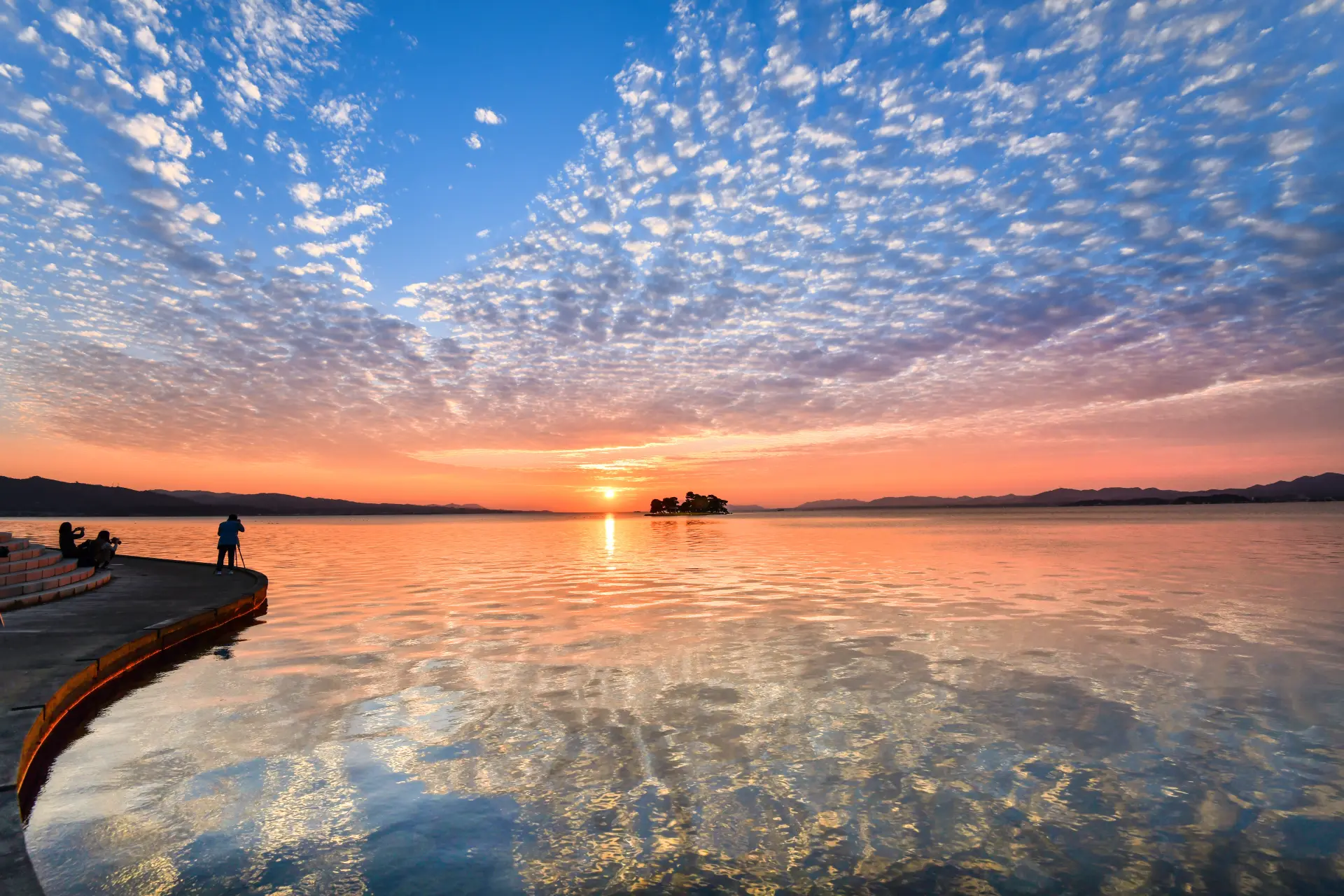
Lake Shinji, known for its beautiful sunsets over the water, is also famous.
This article introduces the appeal of Matsue, focusing on its popular tourist attractions, as well as access information and recommended places to stay.
If you want to make the most of Matsue, be sure to read to the end.
What is Matsue Like?
Matsue is the largest city in the San’in region, which includes Shimane Prefecture, Tottori Prefecture, and northern Yamaguchi Prefecture.
Located between Lake Shinji on its western edge and Nakaumi Lagoon on its eastern edge, with the Ohashi River connecting the two, and also home to the Horikawa moat surrounding Matsue Castle, the city is known as the “City of Water.”
It flourished as the castle town of Matsue Castle during the Edo period, and traces of that history and atmosphere still remain along the Horikawa moat.
A cruise along the moat past samurai residences and Shiomi Nawate feels almost like stepping back in time.
Lake Shinji, selected as one of Japan’s 100 Best Sunsets, is also one of Matsue’s most iconic spots.
Another part of Matsue’s appeal is its abundance of hot springs.
For your stay, Matsue is best enjoyed by using either Tamatsukuri Onsen, one of Japan’s oldest hot spring resorts known for its skin-beautifying waters, or Matsue Shinjiko Onsen, where you can take in the beauty of Lake Shinji, as your base.
There are also many facilities in the city where you can enjoy day-use hot springs, so pair your sightseeing with a relaxing soak.
Local cuisine is another highlight, including Shimane specialties such as Izumo soba, as well as seafood like matsuba crab and Matsue rock oysters, and lake delicacies from Lake Shinji such as winter crucian carp and shijimi clams.

What is the best season to visit Matsue?
Autumn is the best time to visit Matsue.
The fall colors perfectly complement the old-world charm of this historic castle town, making the scenery especially beautiful at this time of year.
Head out to enjoy the autumn leaves at Matsue Castle, shrines and temples, and Japanese gardens.
Also, crab, a winter delicacy of the Sea of Japan, is in season from late autumn through winter, so the cooler months are also highly recommended for food lovers.
What to wear in Matsue by season
- Spring (March - May): light jacket and thin sweater
- Summer (June - August): lightweight clothing, short sleeves
- Autumn (September - November): light jacket, coat
- Winter (December - February): coat, thick sweater or jacket
How do I get to Matsue?
Traveling from Tokyo to Matsue by land takes over 10 hours, so flying is the most common option.
However, since Matsue does not have its own airport, travelers usually go via Izumo Airport (Izumo Enmusubi Airport) in Izumo City, Shimane Prefecture.
It takes Approx. 1 hour and 30 minutes from Haneda Airport to Izumo Airport.
From Izumo Airport, take an airport limousine bus and you will arrive at Matsue Station in Approx. 30 minutes.
From Osaka, take the shinkansen to Okayama and transfer to a limited express train, and you can reach Matsue Station in Approx. 3 hours and 40 minutes.
Main transportation for sightseeing in Matsue
The main forms of transportation in Matsue are trains and buses.
Most major tourist spots can be accessed by bus.
For longer trips across different areas, use JR lines and the private Ichibata Electric Railway.
9 Popular Tourist Spots Where You Can Enjoy the History and Beauty of Matsue
Here are some popular tourist spots where you can enjoy Matsue’s historic scenery and beautiful natural surroundings.
These are must-visit places for any trip to Matsue, so be sure to stop by.
1. Matsue Castle
This hirayama-style castle stands on 29-meter-high Kamedayama Hill near Lake Shinji and was designated a National Treasure in 2015.
It was built about 400 years ago by Horio Yoshiharu, the lord of Izumo and Oki. It is also called “Chidori Castle” because its gables resemble a plover spreading its wings.
The castle tower has four roofs, five floors, and one basement level. The top-floor watchtower, Tengu-no-Ma, served as both an observation deck and a command post, so it has no walls, only railings. From here, you can enjoy a 360-degree panoramic view of Matsue City and Lake Shinji.

2. Tamatsukuriyu Shrine
An ancient shrine recorded in the Izumo no Kuni Fudoki as “Tamatsukuriyu no Yashiro.” It stands deep in Tamatsukuri Onsen, which has a history of 1,300 years, and was beloved in the Edo period as a shrine of the hot spring deity.
Successive lords of the Matsue domain often visited this shrine when staying in the area for hot spring bathing.
Because the area was also a production center for magatama beads, the shrine enshrines Kushiakarutama-no-Mikoto, the deity of bead-making said to have created the Yasakani no Magatama, one of the Three Sacred Treasures, as well as Onamochi-no-Mikoto and Sukunahikona-no-Mikoto, the guardian deities of hot springs who are said to have discovered Tamatsukuri Onsen.

3. Horikawa Sightseeing Boat Cruise
A sightseeing boat cruise that circles the Approx. 3.7-kilometer moat surrounding Matsue Castle, a National Treasure, in a small covered boat. As you listen to the boatman’s humorous commentary, you can relax and enjoy the scenery.
Over the course of Approx. 50 minutes, the cruise passes through three areas: a historic district with impressive samurai residences and stone walls unchanged since the Edo period, a lively downtown district lined with retro-modern buildings, and a natural district where you can observe quiet forests and birds by the water.

4. Lake Shinji Sunset Spot (Torupa)
To let visitors enjoy the sunset over Lake Shinji, which has been selected as one of Japan’s 100 Best Sunsets, a 300-meter stretch of lakeside on the east side along National Route 9 has been developed into a promenade.
It has been designated by the Ministry of Land, Infrastructure, Transport and Tourism as a “Parking Area for Photographing Sunsets (Torupa),” making it a popular photography spot.
With terraces and stepped benches, it offers the perfect place to admire the lake as it glows in crimson hues.

5. Matsue Vogel Park
A flower and bird theme park located on a hillside facing Lake Shinji.
This all-weather facility features four exhibition greenhouses and an observation deck connected by covered walkways, so you can enjoy it without worrying about the weather.
The heart of the park is the Center House, an exhibition greenhouse covering Approx. 8,000 square meters, one of the largest in Japan. About 10,000 flowers, including begonias and fuchsias, bloom here, allowing visitors to enjoy their beautiful full-bloom display throughout the year.

6. Yaegaki Shrine
An ancient shrine dedicated to Susanoo-no-Mikoto and Inatahime-no-Mikoto, the main deities who appear in the myth of the eight-headed serpent Yamata no Orochi.
Because Susanoo-no-Mikoto protected Inatahime-no-Mikoto, defeated the serpent, and later became her husband, many worshippers visit seeking blessings for matchmaking, marital harmony, fertility, and safe childbirth.
The grounds are home to many spots associated with matchmaking, including the Renri no Tamatsubaki, two camellia trees that have grown together at the base like a married couple.

7. Shimane Art Museum
An art museum on the shore of Lake Shinji with harmony with water as its theme. Designed with a low profile to blend into the landscape, the building features gentle wave-like curves and evokes the image of a waterside shore connecting the lake surface and the land.
The collection spans a wide range of genres, including paintings, crafts, photographs, and sculptures. Among them, the museum’s Japanese prints, including ukiyo-e, number more than 3,000 pieces, making it one of the largest collections in Japan.

8. Miho Shrine
Miho Shrine stands in a port town facing Miho Bay, filled with the scent of the sea.
It enshrines Kotoshironushi-no-Kami, the child of Okuninushi-no-Mikoto, who is worshipped at Izumo Taisha. It is said that visiting both Izumo Taisha and Miho Shrine, a practice known as “ryomairi,” brings good relationships.
Kotoshironushi-no-Kami is known not only as a deity of prosperous business, but also as a god of fishing, maritime transport, and protection of rice fields from pests.
Also revered as a deity of music, the shrine has received offerings of various instruments, including Japan’s oldest accordion and music boxes.
Another highlight is the shrine building itself, a nationally designated Important Cultural Property built in the unique architectural style known as Miho-zukuri.

9. Yuushien Japanese Garden
A stroll-style Japanese garden located on Daikonshima Island, floating in Nakaumi Lagoon in Shimane Prefecture, an area famous for peonies and Korean ginseng.
Its grounds span Approx. 12,000 tsubo and feature highlights such as an artificial hill modeled after Mt. Daisen and a waterfall reminiscent of the scenic Oni no Shitaburui Gorge, skillfully recreating the landscapes of the local Izumo area. Visitors can enjoy beautiful seasonal flowers and nature throughout the year.
The highlight in spring is the “Pond Peony” event held from late April to early May. At peak bloom, 30,000 red, pink, and white peonies cover the pond, creating a scene that feels like another world.

Best Areas to Stay: Matsue’s Hot Spring Resorts
If you visit Matsue, staying at a hot spring resort is something you should not miss.
Choose your base based on your preference: Tamatsukuri Onsen, known as one of Japan’s oldest hot springs with skin-beautifying waters and many matchmaking spots, or Matsue Shinjiko Onsen, where you can enjoy beautiful views of Lake Shinji.
1. Tamatsukuri Onsen
One of Japan’s oldest hot spring areas, located in the mountains upstream along the Tamayu River from the southern shore of Lake Shinji.
The Izumo no Kuni Fudoki describes it as a hot spring where “one bath makes you more beautiful, and a second bath cures any illness,” and Sei Shonagon also praised its exceptional waters in The Pillow Book, making it famous as a skin-beautifying hot spring.
The water is rich in sulfate ions and metasilicic acid, and is known for its moisturizing properties.

2. Matsue Shinjiko Onsen
Matsue Shinjiko Onsen is located along the northern shore of Lake Shinji.
Its greatest appeal is that hotels and ryokan lining the lakeside road offer beautiful sunset views over Lake Shinji.
In addition, all hot spring facilities in the hot spring town use high-temperature source water, which not only warms the body thoroughly but also moisturizes the skin.
It is also conveniently located for access to downtown Matsue, Matsue Castle, and Izumo Taisha, making it an excellent base for sightseeing in Matsue and Izumo.
Choose Based on Your Travel Style! 3 Recommended Places to Stay in Matsue
To help you choose accommodations that fit your travel plans, here is one recommended place to stay each from the Tamatsukuri Onsen, Matsue Shinjiko Onsen, and Matsue Station areas.
Whichever one you choose, you are unlikely to regret it.
1. Kai Tamatsukuri
A ryokan in Tamatsukuri Onsen where every room comes with an open-air bath.
You can enjoy the hot spring waters, often called a natural lotion, which were already described 1,300 years ago in the Izumo no Kuni Fudoki as skin-beautifying waters.
There are 24 purely Japanese-style guest rooms, each equipped with an open-air bath made of either cypress or Shigaraki ware and an adjoining sitting room. The large communal bath is especially distinctive, with a water spout shaped like a shrine.

2. Minamikan
Minamikan is located a little away from the Shinjiko hot spring district.
Its 19 guest rooms across six types each have their own character, yet all offer a space where you can feel the charm of traditional Japan.
Many rooms, including the top-floor lake-view suite, look out over Lake Shinji, allowing you to relax and watch the sun slowly set over the water.
In addition to the communal bath, where you can unwind in clear skin-beautifying waters and the soothing scent of cypress, the lake-view suite also comes with its own observation hot spring bath.

3. Green Rich Hotel Matsue Ekimae
Green Rich Hotel Matsue Ekimae is conveniently located Approx. 2 minutes on foot from the north exit of JR Matsue Station.
One of its main features is the original bedding installed in every guest room, developed through years of pursuit of “high-quality relaxation and more comfortable sleep.”
Another welcome point is that, despite its station-front location, the hotel also has a large communal bath with artificial hot spring water.
Enjoy the breakfast buffet with both Japanese and Western options before heading out to explore Matsue.

FAQ about Matsue Sightseeing
Q
Where should I go to enjoy Matsue in a short amount of time?
A
We recommend visiting Matsue Castle and exploring the surrounding castle town along the Horikawa moat.
Q
What local specialties should I eat in Matsue?
A
We recommend trying seafood such as matsuba crab and Matsue rock oysters, as well as lake delicacies from Lake Shinji such as winter crucian carp and shijimi clams.
Summary
Centered around Matsue Castle, Matsue preserves the scenery of old Japan and offers beautiful natural landscapes, hot springs known for their skin-beautifying waters, and plenty of spiritual power spots.
Using this article as your guide, you will be able to fully experience Japan’s history, culture, and beauty.
If you are planning to explore other parts of Shimane as well, be sure to check out the article below.