

Relax with Soothing Scents! A Guide to Japanese Incense
Incense can make everyday life feel a little richer. A pleasant fragrance instantly helps you relax. In Japan, there is a long-standing culture of enjoying incense as a way to refresh the mind in the midst of busy modern life. Here, we introduce the deep and fascinating world of Japanese incense, which has been part of daily life for centuries.
The History of Incense in Japan
Incense was introduced to Japan more than 1,400 years ago. It is believed to have arrived together with Buddhism around 538 during the Asuka period. In Nihon Shoki, the oldest historical chronicle compiled in Japan in 720, there is a description of jinkō (aloeswood), an ingredient used in incense (more on this later), and this is considered the oldest written reference to incense in Japan.
Later, during the Nara period, incense was often used in religious contexts, such as purifying spaces before Buddhist altars. It is also said that when the Chinese monk Ganjin (688–763), who greatly contributed to the development of Buddhism in Japan, came to Japan from Tang China in 753, he brought with him many aromatic medicinal materials and techniques for blending incense.
Aristocrats, who had learned about incense as part of Tang-style refinement, gradually began to enjoy it not only for religious purposes but also in daily life, and during the Heian period, incense culture spread among the nobility, who were at the center of politics. Literary works from this era, such as The Pillow Book and The Tale of Genji, also depict the use of incense. At that time, people made takimono, blended incense prepared by mixing fragrance ingredients themselves, and gently heated it over charcoal to scent rooms, hair, and clothing such as kimono. Takimono was apparently made by grinding ingredients such as jinkō, clove, and sandalwood into powder, then kneading them together with plum pulp or honey. Later, during the Kamakura period, when Zen Buddhism spread, the practice of monkō, carefully focusing on and savoring the fragrance of aromatic wood, was established.
In the Edo period, kumikō, incense-comparing games, spread not only among nobles and samurai but also among townspeople, who supported the economy. Tools for enjoying incense were developed, formal manners for appreciating fragrance were established, and incense appreciation became recognized as a “way,” or dō. Around the same time, techniques for making stick incense were introduced from China, and its use spread among ordinary people as well.
Ingredients and Places of Origin of Incense
Fragrant Woods
One of the ingredients used in incense is kōboku, naturally fragrant wood. There are three representative types of fragrant wood: sandalwood, jinkō, and kyara. Even within the same type, each piece of wood has its own distinct scent, and some are rare and difficult to obtain.

, Sandalwood
This is the most common fragrant wood and is cultivated in places such as India, Indonesia, and Malaysia. “Rōzan sandalwood,” grown in the Mysore region of India, is considered the highest quality. In addition to incense, it is widely used for carved crafts, fans, and even medicinal purposes.
, Jinkō (Aloeswood)
This is a rare fragrant wood formed over a long period of time by natural processes in the tropical rainforests of Southeast Asia, including the Indochinese Peninsula and Indonesia. Resin gathers and hardens in parts of the tree due to various external factors such as damage, and as the tree itself gradually dies, the wood matures into fragrant wood. The name jinkō is an abbreviation of jinsui kōboku, meaning “fragrant wood that sinks in water.” In addition to being used as a fragrance material, it has long been used medicinally as well.
, Kyara
Kyara is a type of jinkō. It is formed through almost the same process, but due to differences in its fragrance and oil content, it is regarded as being in a class of its own. In the past, it was collected in limited areas of Vietnam, but this has become difficult today, making it one of the most precious fragrant woods.
These fragrant woods are also processed into various forms depending on how they will be used.
, Kizami
Finely chopped fragrant wood. Recommended not only for oshōkō powdered incense offerings, but also for soradaki, or room fragrance.

, Tsume
Ideal not only for Buddhist use but also for soradaki. It is cut into a long, narrow shape.

, Boku
This is the form closest to the natural state of the wood. Users cut it into their preferred size before use.

, Kasane
A form used only for sandalwood. It is useful for protecting hanging scrolls and rolled scrolls from insects.

, Wari
This form is often used at tea gatherings, for Buddhist rites, in tea lessons, and for soradaki.

, Kakuwari
A neat, squared form used in Buddhist rituals and the tea ceremony.
Incidentally, these forms of fragrant wood are sometimes used differently according to the traditional Japanese concepts of hare and ke. Hare refers to special days such as festivals and ceremonies, while ke means ordinary daily life. Tsume and kizami, which are slightly more affordable because of their irregular shape, are recommended for everyday use as “ke incense.” On the other hand, carefully shaped kakuwari is used as “hare incense” for special occasions.

Natural Fragrance Ingredients
Besides fragrant wood, there are dozens of other natural fragrance ingredients used in incense, and because they are natural products, many are difficult to obtain. Some have long been familiar as spices or herbal medicines, so quite a few of these ingredients may already sound familiar.
, Keihi
Dried bark of the Chinese cinnamon tree (family Lauraceae). Also known as cinnamon. It is harvested in places such as southern China and Vietnam.

, Chōji
Dried flower buds of the clove tree (family Myrtaceae). In the West, it has long been used as the spice clove.

, Daiuikyō
Dried fruit of the star anise plant (family Schisandraceae). Also called hachikaku uikyō, or star anise, it is also used as an essential spice in Chinese cuisine. It is produced in southern China, including Guangdong and Yunnan.

, Ansokkō
A resin collected by cutting the trunk of the benzoin tree (family Styracaceae) and gathering the sap that seeps out. It is produced in large quantities in Sumatra.

, Ryūnō
Crystals from the sap of the camphor tree known as ryūnōju (family Dipterocarpaceae). It is used as an incense ingredient and as an insect repellent. It is mainly produced in Sumatra and Borneo, but it also became a topic of interest when it was excavated from the Marukoyama Kofun burial mound in Japan.

, Nyūkō
A resin that seeps from the trunk of a tree called nyūkōju (family Burseraceae). It is produced in northeastern Africa and along the Arabian Sea coast. It is also used in Christian rituals.

, Sanna
A plant native to Vietnam, this ingredient is made by drying and slicing the rhizome of banukon, a member of the ginger family, mainly harvested in southern China and Vietnam.

, Kakkō
A dried herb from the mint family native to the Philippines. This plant is also called patchouli and blooms with white to pale purple flowers.

, Kaikō
The operculum of a sea snail. It is used as a fixative to help fragrance last longer. It is the only animal-derived ingredient. Today, kaikō from the northeastern coast of Africa is commonly used.

Incense is made by blending these fragrant woods and natural fragrance ingredients. Although incense itself is a traditional part of Japanese culture, most of its raw ingredients are imported from countries across the world, including Southeast Asia, China, India, and West Asia.
Types of Incense
Some incense is lit directly, while some releases fragrance at room temperature without anything being done to it. There are many different forms and ways to use it. It is best to choose the type depending on the situation in which you want to use it.
1. Incense That Is Lit Directly
This type is used by placing or standing the incense in an incense burner or holder.
, Senkō (Stick Incense)
Because it is often used for Buddhist rites, this is the type of incense most familiar to Japanese people. There are many kinds and lengths depending on the purpose, such as indoor incense and incense for Buddhist services. The longer the stick, the longer it burns. Because it can be easily snapped, you can break off only the length you want to use, making it convenient and easy to adjust the burning time. Since the burning surface area is uniform, the fragrance also spreads evenly.
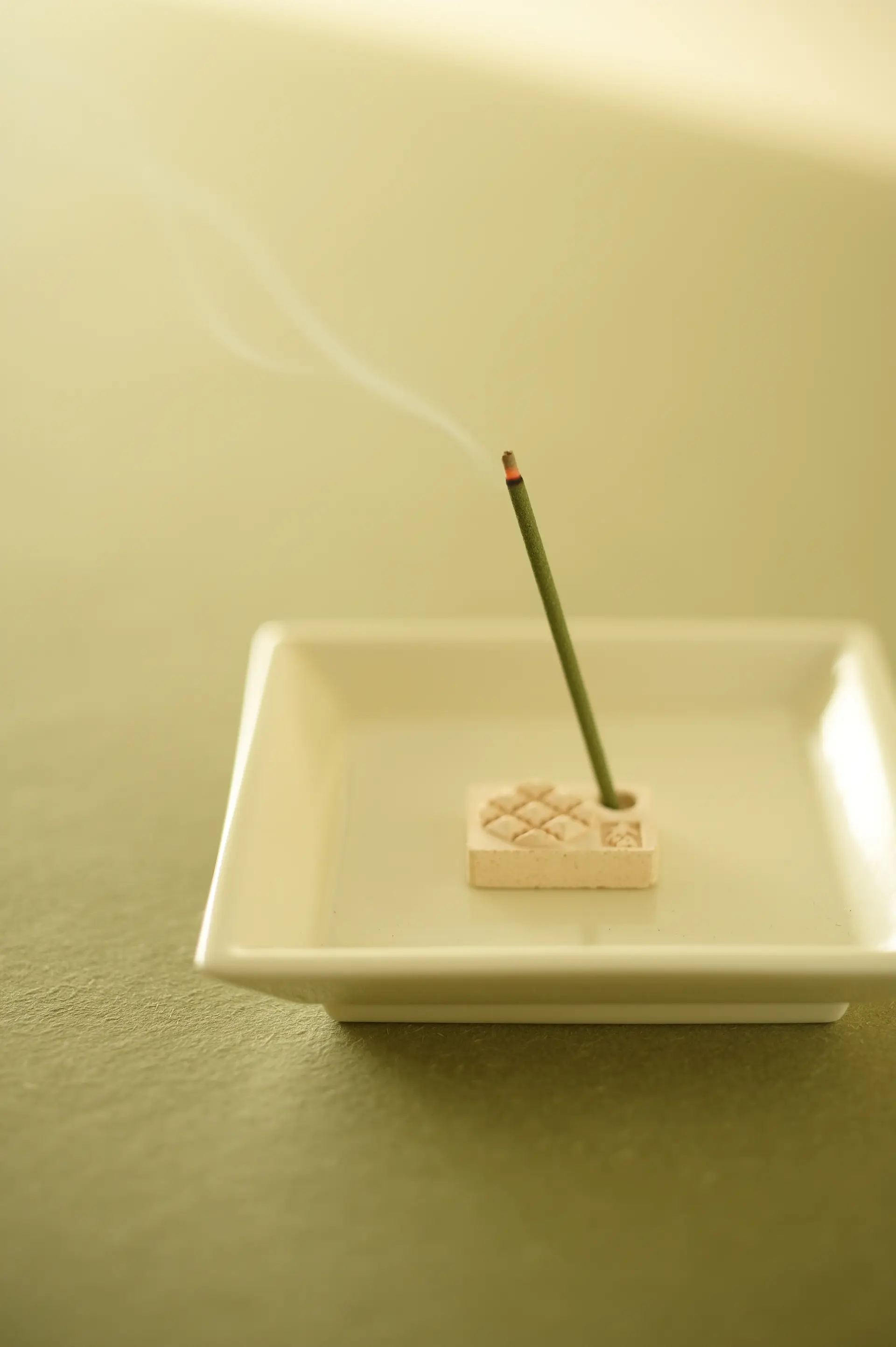
How to use stick incense
To use stick incense, prepare an incense plate (or a small ceramic plate), an incense holder, and a lighter. Hold the lighter perpendicular to the floor when lighting it. Bring the tip of the incense close to the flame and light it. Once it catches fire, quickly lower the incense straight down to extinguish the flame. Another tip is to fan it with your hand and put the flame out at once with strong air pressure. Do not shake the incense to extinguish it, as this is dangerous. Then place the stick incense in the holder set on an incense plate large enough to catch the ash, and enjoy the fragrance.
, Cone Type
This type is used by lighting the tip of the cone. Because of its cone shape, the burning surface area increases as it burns, and the fragrance gradually becomes stronger as well. This type is convenient when you want to enjoy fragrance in a short time. Since the ash remains in the cone shape, it does not scatter easily and is simple to clean up.
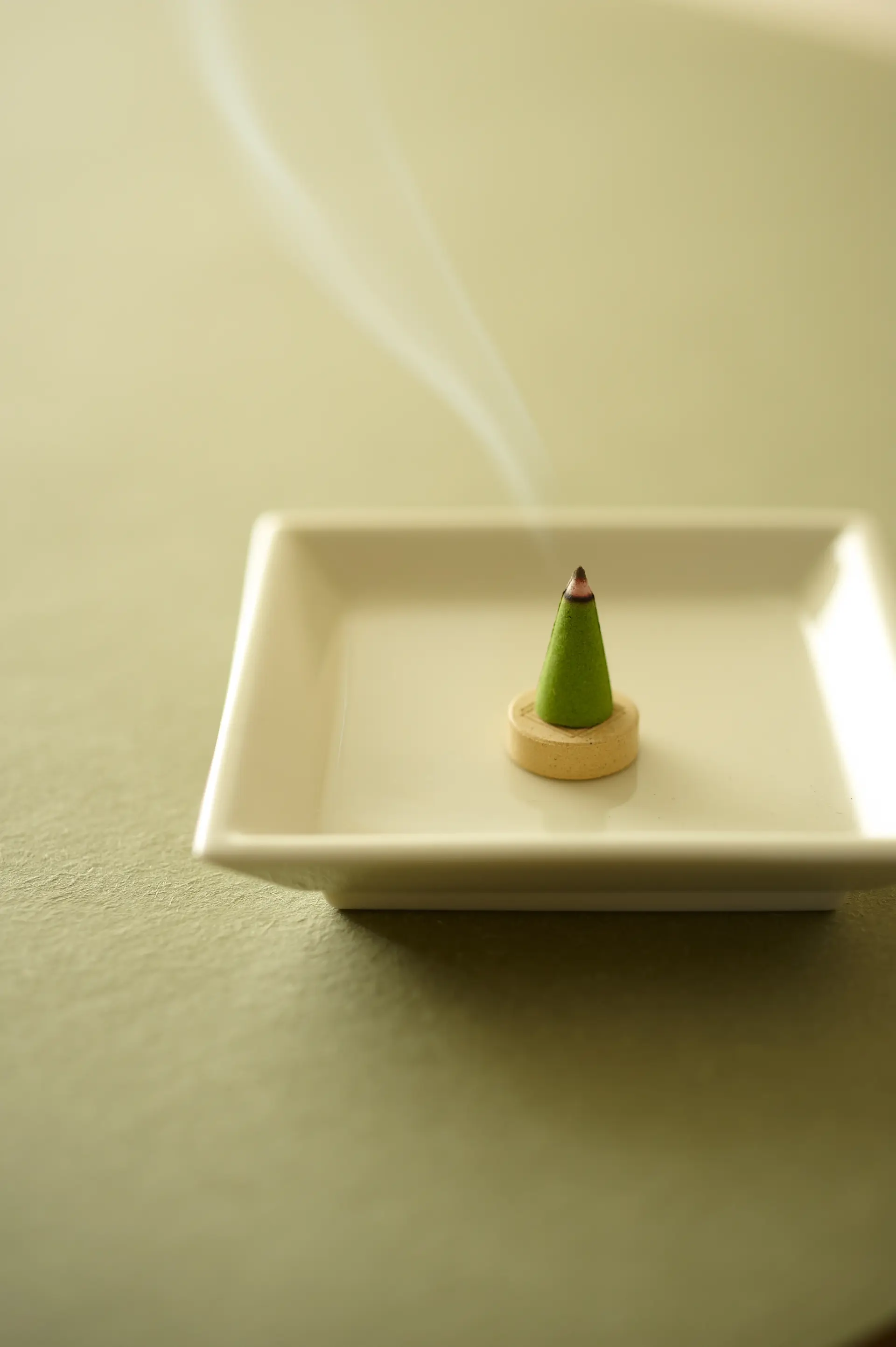
How to use cone incense
To use cone incense, prepare an incense plate (or a small ceramic plate), an incense holder, and a lighter. Bring the tip of the cone close to the lighter flame and light it. Once it catches fire, quickly lower the incense straight down to extinguish the flame. It is also fine to fan it with your hand and put the flame out at once with strong air pressure, but avoid shaking the incense itself to extinguish it. Once lit, place the incense on the holder set on the incense plate and enjoy the fragrance.
, Coil Type
Because of its spiral shape, this type has a long burning time. That makes it ideal for large rooms or places with a lot of airflow. You do not need to use it all at once. If you want to put it out midway, you can simply break it or pinch the part you want to extinguish with a metal clip or something similar.

How to use coil incense
To use coil incense, prepare an incense plate (or a small ceramic plate), an incense holder, and a lighter. Light the tip of the coil with the lighter. Unlike stick or cone incense, the spiral shape means you need to be careful not to let the fire spread to a neighboring section when lighting it. Tilt the incense slightly and quickly lower it straight down to extinguish the flame. Place it on the holder set on the incense plate and enjoy it.
2. Incense That Gives Off Fragrance at Room Temperature
This type is blended to release fragrance at room temperature without using fire. That means you only need to place it in the space where you want the scent to spread. It is easy to enjoy and is also used as room decor or as an accent for clothing. In addition to scented sachets, there is also bookmark-shaped incense. It can be tucked into books, wallets, or business card holders. More recently, scented straps have also become available, and if you attach one to your cellphone or bag, a gentle fragrance will follow you anywhere, letting you enjoy scent in many situations. The fragrance is not as strong as perfume, just softly scented, so it is easy to use in any setting.
, Scented Sachets
Inside the pouch is nioikō, a blend of finely chopped fragrance ingredients such as sandalwood, clove, spikenard, and borneol. It is a type of fragrant sachet used not only in dressers, but also slipped into kimono accessories or sleeves to transfer fragrance to clothing. For Western-style clothing, you can also enjoy it by placing it in a pocket or inside a pouch or other small accessory.
You can also make this type of scented sachet yourself. When the fragrance of your treasured sachet begins to fade, you can keep using it by simply replacing the incense inside. What you need are nioikō, a drawstring pouch, thin washi paper, tape, and a spoon. First, wrap an appropriate amount of nioikō in thin washi paper so it will not spill, and secure it with tape. Then place it inside the pouch, and it is done. It is very easy to make. Why not try making one with your favorite fragrance blend and your favorite pouch?

3. Incense Heated Indirectly
, Nerikō
This is a pill-shaped incense made by adding honey or plum pulp to powdered fragrance ingredients, kneading them together, and allowing the mixture to mature. At tea gatherings, incense is burned to purify the space, and nerikō is mainly used for this purpose.
Nerikō is originally something you enjoy by combining various fragrance ingredients to create a scent to your own taste. One of the pleasures is how the fragrance changes depending on the blend. What you need are fragrance ingredients, honey, a mortar, and a pestle. Blend the ingredients to create your preferred scent and mix them together. Then add honey and knead well using the pestle. Roll the mixture by hand into suitable small balls, and it is complete. Some places also sell nerikō blending kits, so it is recommended to start with one of those.

, Inkō
There are mainly two ways to enjoy fragrant wood. One is monkō, in which you quietly appreciate the delicate nuances of the fragrance. The other is soradaki, which fills a room with scent. The key is to change the method depending on your purpose.

4. Specialized Incense
Here are some types of incense used in temples and Buddhist ceremonies.
, Long Stick Incense
These are long-burning incense sticks measuring 33 cm to 73 cm. Those over 70 cm continue burning for around 6 hours. They are also used to measure time, with the duration of chanting sutras or practicing zazen sometimes defined as “until one stick of incense burns out.”

, Zukō
A powdered incense. It is used as an offering to the principal Buddhist image, and also applied to the body by practitioners to purify themselves and keep away impurity. It is also used when copying sutras.

, Makkō
A very fine powdered incense. It is used mixed with ingredients such as jinkō and sandalwood. It is mainly burned before Buddhist altars.

, Shōkō
An incense made by finely chopping and blending fragrant woods and aromatic herbs. The basic blend consists of five ingredients: jinkō, sandalwood, clove, turmeric, and borneol.

How to Enjoy Incense
, Monkō
- Light the charcoal
- Bury the charcoal in the ash
- Rake up the ash
- Shape the ash into a mound
- Create an air hole to let the heat pass through
- Place a silver mica plate on top
- Place a small piece of fragrant wood on the silver mica plate
- Listen to the fragrance

, Soradaki
- Light the charcoal
- Warm the ash
- Place the incense on the warmed ash

As you can see, enjoying incense once required time and effort. Today, however, electric incense burners are also available, so you can enjoy incense just a few minutes after switching one on, without needing to light charcoal or warm ash.

Shoyeido, a Long-Established Maker Preserving Tradition
Incense has long been part of Japanese daily life. While preserving this tradition, Kōrōho Shoyeido Kyoto Main Store in Nakagyo Ward, Kyoto City, continues to create fragrances suited to the way people live today as times change. It is a long-established incense maker with more than 300 years of history. The wide variety of incense created through tradition-backed experience, knowledge, and skill reflects the company’s unwavering commitment to making beautiful fragrances without compromise.

The store faces Karasuma Street, a little north of Nijo Street. In fact, the Nijo area has long been home to many medicinal wholesalers, and during the Edo period it was an officially recognized “medicine town” under the shogunate. At its peak, there were said to have been more than 100 such shops. Since medicinal wholesalers naturally had easy access to Chinese herbal ingredients, which are also used in incense, Shoyeido has continued to preserve fragrance culture in this setting through the generations. Backed by rich experience, knowledge, and technical skill cultivated through tradition, the company produces everything from incense for religious use to incense for tea ceremony and Japanese rooms, as well as highly artistic incense and scented sachets. While preserving tradition, it continues to create new fragrances in step with changing times.
Inside the store, rows of products featuring traditional Japanese-style fragrances line the shelves.

Another line is the Xiang Do series, known for its pure fragrances, which comes in 16 varieties including Rose and Mixed Berry.

When we asked a Shoyeido representative, “Wait, are roses really used as an incense ingredient?” we learned that instead of using roses directly, they express a rose fragrance using traditional ingredients and essential oils.
Shoyeido also collaborates with globally known characters and beloved Japanese anime. One example is this stick incense.

The cross section is shaped like Mickey Mouse. Making stick incense already requires delicate craftsmanship, yet they can even create this kind of curved Mickey Mouse design. It was impossible not to feel the pride of a long-established incense maker through products like these.
Of course, you can purchase incense and related goods here. Be sure to talk with the staff about how and in what situations you would like to use it as you choose your products. It is certainly easy to shop online these days, but here you can buy while speaking with staff who know incense inside and out, and if there is a product that interests you, they may even light it for you so you can smell the fragrance. Since the scent changes slightly before and after it is lit, it is nice to be able to try the ones that catch your attention.
Kunjukan, a Facility Where You Can Experience Fragrance
Next to Shoyeido is a place where you can deepen your knowledge of fragrance and discover your favorite scent. It is a facility called Kunjukan. Here, you can explore, learn about, and enjoy fragrance.

Opened in July 2018, this popular spot welcomes as many as 100,000 visitors a year. It is operated by Kōrōho Shoyeido, the long-established Kyoto incense maker introduced above. When you enter the Kunjukan building, you are greeted by an extremely long incense stick. It measures an impressive 120 cm.

This was specially made to match Kunjukan’s 7-hour opening time. When we visited, more than half of it had already burned. Seeing it like this makes you realize that incense can also mark the passage of time. Just to the right after entering is a space called Fragrance Walk.

Here, you can experience a variety of scents. Hanging from the ceiling are three white boxes.

These are called Kaori Boxes. If you put your head inside, you will find them filled with pleasant fragrance. This corner was created with the hope that visitors could enjoy scent in a pure way, free from preconceived impressions caused by sight, sound, and other senses. Each of the three boxes contains a different type of incense, so it seems fun to visit with friends and guess what scents are being used. There is also a stand where you can place your smartphone at the photo spot, so you can even take a picture with your head inside the box.
Further back beyond the Kaori Boxes is the Fragrance Pillar corner.

Here, you can experience the scents of the raw ingredients used in incense. Bring your nose close to the white horn-shaped part and press the pump, and the fragrance of the ingredient is released. There are familiar ones such as keihi and ryūnō, as well as musk taken from the scent gland in the abdomen of the male musk deer, an ingredient whose trade is now banned under the Washington Convention. We were told that the musk on display had originally been kept for research purposes. Being able to experience the scent of musk in Japan is rare, and this may be the only place you can do it.
There are also exhibits such as miniatures showing manufacturing processes from the Edo period and a giant sandalwood tree, allowing you to deepen your knowledge of fragrance and incense through hands-on experiences.
You can also try a gacha machine for scented sachets or stick incense for 500 yen, called “Kun Gacha.”

What kind of fragrance you will encounter is part of the fun. In this way, Kunjukan is filled with opportunities to discover a wide variety of scents.
Inside the Workshop Where Stick Incense Is Made
This time, we were allowed to observe how stick incense is made on the second floor of Shoyeido Kyoto Main Store. Around Approx. 60,000 sticks are produced in this workshop each day. As soon as we stepped inside, the air was filled with a wonderful fragrance!
1. Measuring, Blending, and Mixing
The fragrance ingredients are first turned into powder and measured out. The ratios in these complex blends are a secret known only to the blender. Apparently, even people responsible for the other production steps do not know them. Next, tabu powder, which acts as a binder, is added to the fragrance ingredients and mixed. After mixing, the ingredients are sifted so they are blended evenly.
2. Kneading
Next, the sifted ingredients are placed into a large kneading machine. While stirring, water and coloring are added, and the mixture is kneaded for 20 to 30 minutes until it becomes clay-like. The amount of water is adjusted according to the temperature and humidity, with the goal of achieving a softness similar to an earlobe. Because the amount is adjusted by feel at the fingertips, this step is handled by veteran craftspeople with highly refined skill and intuition.

3. Extruding and Cutting on the Tray
The kneaded material is then placed into a hydraulic extruder and pushed out through small holes. About 70 soft, freshly formed incense sticks slowly emerge.

These are received on a board called a bonita, and both ends are trimmed using a bamboo spatula.
I was also given a special chance to try it myself, but the soft clay-like incense sticks overlapped and would not settle neatly onto the board. Then, when I trimmed both ends with the bamboo spatula, too much pressure bent the still-soft incense. It was difficult. We were told that this step, too, is handled by craftspeople who have spent years working in incense production. Seeing how each stage is entrusted to a specialist made me appreciate all the more how those beautiful, perfectly straight incense sticks are created.
4. Nama-tsuke
Next, the soft incense sticks on the tray board are transferred to a long board called a tehonita.

They are then laid out tightly with no gaps and aligned carefully. We were told that if gaps are left here, the incense may end up bending. Any parts extending beyond the tehonita are trimmed off, and the sticks are moved onto drying boards.

Pre-drying is also done here, and as drying progresses, tiny gaps appear again, so the sticks are nudged together to close those gaps.


Until they are moved to the drying room for the next step, this aligning work is repeated 2 to 3 times a day.
5. Drying
The incense sticks are moved into a drying room and dried over 2 to 3 days while air is circulated with fans. The humidity and temperature in the drying room are kept constant, and they change depending on the season. When asked, “Why not dry them all at once efficiently with heat?” the answer was, “Doing so can cause the fragrance to dissipate and the incense sticks to bend.” It was a reminder of just how delicate incense making is.
6. Final Packaging
Once fully dried, the incense sticks are bundled and packed. At this stage, any sticks that are bent are sorted out as non-standard, but they are used as fragrance samples in stores.
The incense is made using an almost unchanged traditional method. Tours are also available by reservation, giving visitors a close-up look at the traditional skills that craftspeople have preserved and passed down. For details, please contact Shoyeido.
Shoyeido Directly Managed Stores
, Kyoto Main Store / Kunjukan
- Postal Code
- 〒604-0857
- Address
- East side, north of Nijo on Karasuma-dori, Nakagyo Ward, Kyoto City Google Maps
- TEL
- 075-212-5590
, Sannenzaka Store
- Postal Code
- 〒605-0862
- Address
- Inside Seiryuen, 3-334 Kiyomizu, Higashiyama Ward, Kyoto City Google Maps
- TEL
- 075-532-5590
, Kyoto Station Kunkun
- Postal Code
- 〒600-8214
- Address
- 8-3 Higashishiokoji Takakuracho, Shimogyo Ward, Kyoto City Google Maps
- Access
- Inside Asty Road, 1F, Hachijo Exit side, JR Tokai Kyoto Station
- TEL
- 075-212-5590 (main office)
, Osaka Honmachi Store
- Postal Code
- 〒541-0053
- Address
- Honmachi Garden City 1F, 3-6-4 Honmachi, Chuo Ward, Osaka City Google Maps
- TEL
- 06-6121-5590
, Ginza Store
- Postal Code
- 〒104-0061
- Address
- 7-3-8 Ginza, Chuo City, Tokyo, 1F (along Sotobori-dori) Google Maps
- TEL
- 03-3572-6484
, Ningyocho Store
- Postal Code
- 〒103-0013
- Address
- 2-12-2 Nihonbashi Ningyocho, Chuo City, Tokyo Google Maps
- TEL
- 03-3664-2307
, Yokohama Store
- Postal Code
- 〒220-0004
- Address
- JPR Yokohama Building 1F, 1-5-10 Kitasaiwai, Nishi Ward, Yokohama, Kanagawa Google Maps
- TEL
- 045-412-5590
, Sapporo Store
- Postal Code
- 〒064-0808
- Address
- 12-3-6 Minami 8-jo Nishi, Chuo Ward, Sapporo City Google Maps
- TEL
- 011-561-2307
Summary
When you step into Shoyeido or Kunjukan, you are surrounded by the wonderful fragrance of incense that has long been part of everyday life in Japan, and it leaves you with a happy feeling. This time, after touring the workshop, we were given some incense. Later, when I burned it at home and breathed in the fragrance, I found myself vividly recalling what I had heard that day, along with the presence and passion of the craftspeople in the workshop. It made me realize how strongly scent is tied to memory among the five human senses. Incense is perfect both for your own enjoyment and as a souvenir. When you visit Japan, we hope you will stop by Shoyeido, relax with its fragrances, and take both the scent and your memories home with you.
*References:
Kōrōho Shoyeido. About Incense https://www.shoyeido.co.jp/incense/index.html
Kodansha BC Official Page, Manga Social Studies Tour Series http://www.toyokuni-bc1.net/bcbook/series_01/

Author
Freelance Announcer
Sayaka Motomura
Focused on sharing insights related to traditional culture, performing arts, and history.